FIT Asia hosts its third global online lecture on literary translation
September 24, 2026
The Asian Regional Centre of the International Federation of Translators (FIT Asia) hosted the third session of its Global Online Lecture Series on 29 June, featuring Dr. Sugeng Hariyanto, who spoke on literary translation in an era of rapid AI development. The session was chaired by Prof. Defeng Li, Distinguished Professor of Translation Studies and Associate Dean of Faculty of Arts and Humanities at the University of Macau, and Board Member of FIT Asia.
Dr. Sugeng Hariyanto is an Indonesian translator, senior faculty member at State Polytechnic of Malang, Founder of Transkomunika Kencana, and Head of the Committee for Competency and Certification at the Association of Indonesian Translators (HPI).
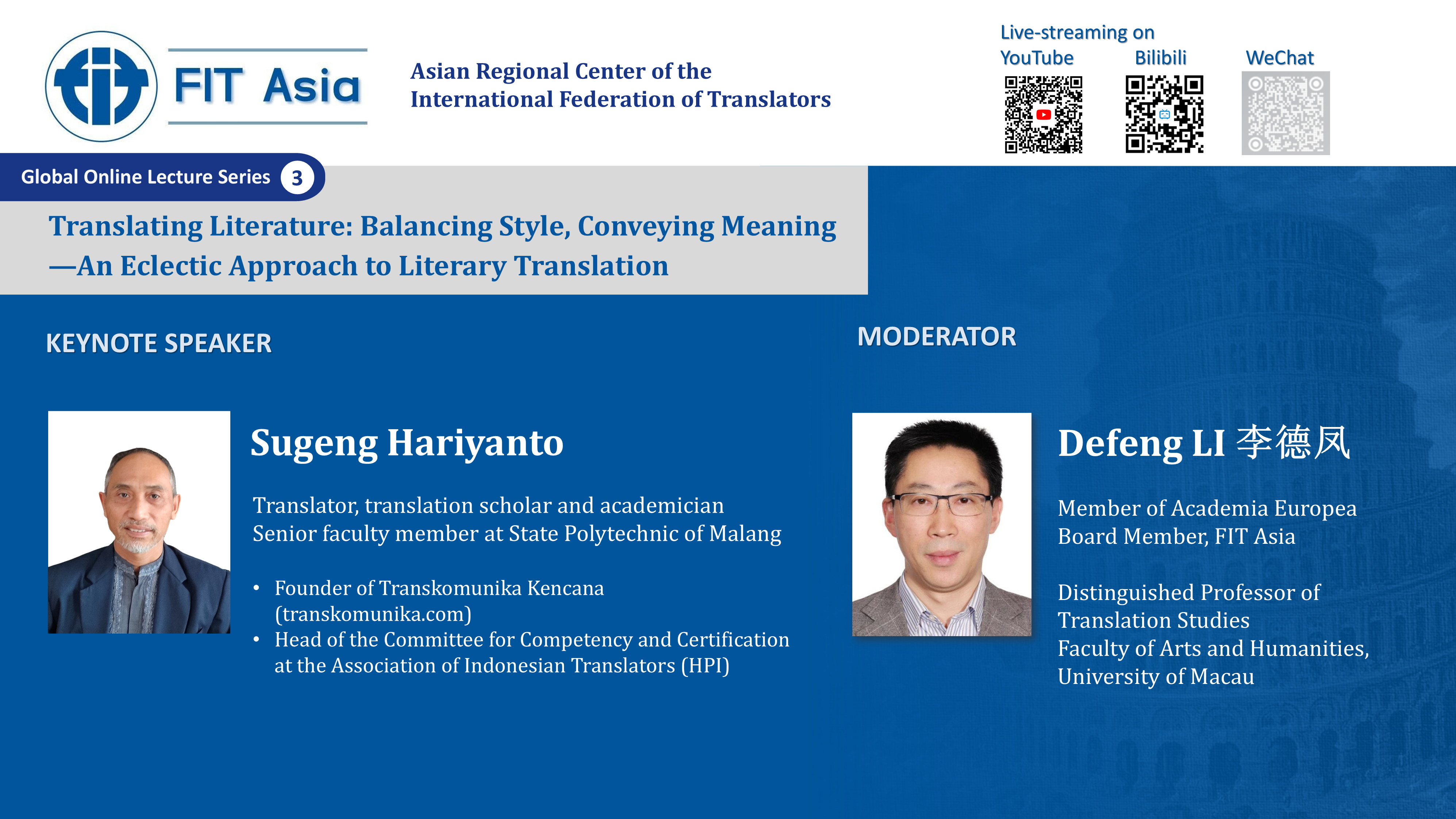
In his lectureTranslating Literature: Balancing Style, Conveying Meaning—An Eclectic Approach to Literary Translation, Dr. Sugeng Hariyanto addressed the aesthetic paradox of AI translation. While AI tools can achieve linguistic fluency through statistical prediction, they often struggle to capture and reproduce the deliberate linguistic deviations, idiolects, and cultural nuances that define literary art. He introduced the Literary Eclectic Approach, a multidimensional framework grounded in linguistic, literary, functional, and cultural-ethical considerations.
Drawing on a case study of Indonesian translations of John Hollander's 1969 concrete poemSwan and Shadow, Dr. Sugeng Hariyanto illustrated how his approach integrates hermeneutics, structuralism, stylistics, and semiotics as the four analytical lenses.He demonstrated that AI-generated translations could not preserve the poem's iconic swan-shaped typography, sibilant soundscape, or layered symbolism, such as the“pool of opened eye” metaphor. In contrast, human translators, working through macro-segment rewriting, phonological re-creation, and symbolic modulation, succeeded in reconstructing both the visual form and the emotional resonance of the work.
Dr. Sugeng Hariyanto concluded that AI should not be seen as replacing human translators, but as liberating them to take on more creative roles, such as co-authors, style curators, and guardians of cross-cultural emotional resonance.
The session was live-streamed globally via YouTube, Bilibili, and WeChat. Please stay tuned for more sessions to come.

